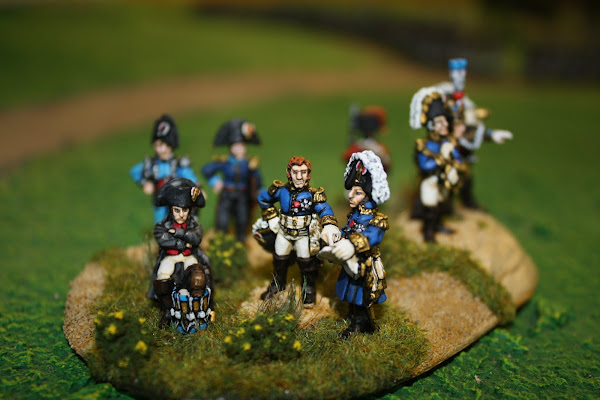
Big Muddy Historical Game Alliance, St Louis, MO hosts 2 conventions a year, plus several monthly game days on the St Louis area. Website: BMHGA.org
The spring convention, Barracks Battles was held May 15/16/17, 2009. The following is the after action report on the Napoleonic battle that took place over the span of several sessions:
BATTLE OF KULM
After the defeat at Dresden, Coalition forces fell back, up the mountain valley, through Kulm and beyond. The area west of the town was the Russian field hospital, and open mass graves. The road through the Kulm Valley was littered with debris, abandoned equipment, and wreckage. The French objective was to brush aside any enemy rear guard, pursue the enemy’s withdrawal, and capture the area around the windmill beyond the ridge at the west end of the Kulm Valley.
The day opened with the French advancing into the Kulm valley from the east. Russian rear guard forces were positioned south of the village, behind the Kulmbach, a stream that ran south from the mountains. Only a pair of small Cossack detachments covered the withdrawal of ambulances and wagons that sought to evacuate the wounded from the field hospital in the open fields around the town. The Russians did manage to evacuate almost half of the wounded, but most were over run by the French, and were subsequently caught in the midst of the battle to follow.
Beyond the ridge to the west end of the valley, the Russians had a massive, well prepared defensive position, centered around Windmill Hill. The hill provided an excellent observation point for the Russians to observe the French advance. However, the Russians advanced from their prepared position to meet the French in Kulm valley. Instead of the Russian rear guard drawing the French into the teeth of the fortified position, the battle raged in the open areas around the town. Both the Russians and the French attempted to force their way across the Kulmbach. Wild cavalry melees between the outnumbered French, and an Austrian cavalry division plus the Russian cavalry raged across the open spaces, forcing infantry into defensive squares. Thunderous artillery exchanges reduced both sides’ batteries. Infantry firefights blazed away across the Kulmbach ravine and the hill beyond. Although costly to both sides, this fight was largely inconclusive.
Meanwhile, in the canyon to the south, two massive Austrian infantry divisions pressed inexorably forward. For two long days, outnumbered French infantry sacrificed themselves to prevent the Austrians from falling on the south flank of the battle in the Kulm valley. Only the presence of a few small detachments of French cavalry slowed the Austrians, and enabled the French to survive the fight and hold the flank position.
A Prussian Division arrived on the field from the east on the second day. This force effectively sealed the French in the valley. With unyielding Russians to the west, Austrian forces pushing up from the south, and Prussians blocking the French rear in the east, the French appeared to be in dire straits. The small brigade of Prince Emil de Hesse and the Corps Reserve were thrown against the Prussians with one order: Clear the road, and secure the means of escape. Furious attacks struck back and forth between the French and Prussians in the east end of the valley, and the French and Russians at the west end of the valley, at the Kulmbach. French cavalry of the reserve disposed of the Prussian horsemen, and later swept the Prussian infantry and artillerists away, opening the escape road to the east.
Finally, with superior numbers of Coalition allies crushing in on the French position, the French withdrew from the field. The French rear guard inflicted some damage, and slowed the Russo-Austrian pursuit force. But overall, the French goal of chopping up the retreating Coalition force was foiled by determined counterattacks, a major Austrian commitment, and the surprise of Prussians arriving in the French rear areas.
But things could have gone much worse for the French. If the Russians had drawn the French in on the prepared position, the Russians would have had the advantage of fieldworks. If the Austrians had pressed harder and chewed up the French flank detachment, the massive Austrian infantry force would have crashed into the French south flank. And if the Prussians had held their blocking position in the east, the French force as a whole could have been trapped and virtually eliminated. This is what happened historically – the French corps was almost entirely wiped out, with only scattered, fragmented units being able to hack their way out of the Kulm valley, or disperse into the mountains, to rejoin the French Army days or weeks later.